
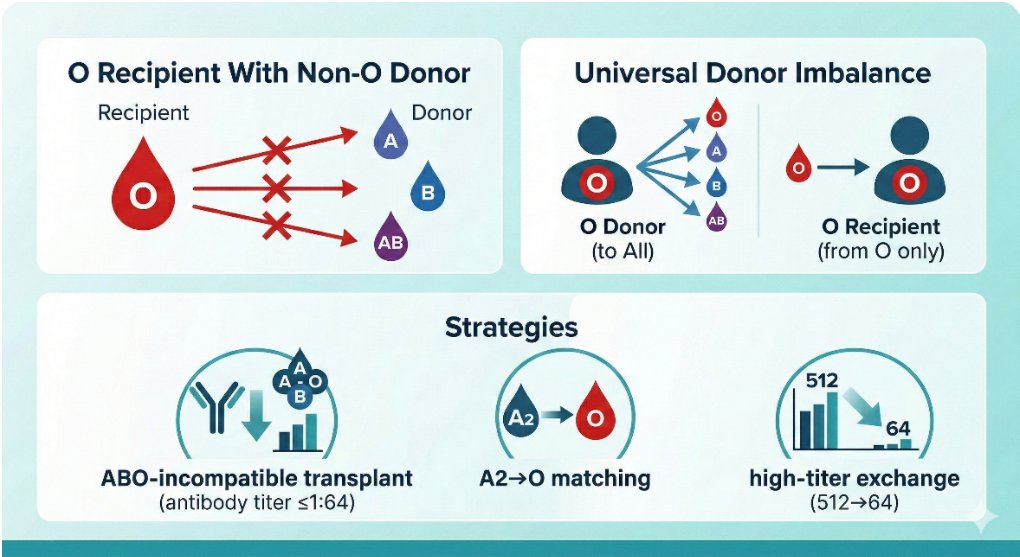
Blood Group O Recipients With Non-O Donors
In kidney paired donation (KPD) registries, it is especially hard to match blood group O recipients who have non-O donors. Since O recipients can usually only receive kidneys from O-type donors, a pair with a non-O donor (A, B, or AB) is considered “incompatible” and has a lower chance of matching.
The following factors and strategies define the experience of this specific group within KPD programs:
- The Biological Imbalance
- Waitlist accumulation: O-type donors are “universal” and can be matched with any blood group, so their kidneys are often used for non-O recipients. This means O recipients, who can only receive O kidneys, often wait much longer in the registry.
- Match probability: O recipients have a much lower chance of finding a match in a KPD pool than other groups. Non-O recipients have about a 60% chance, while O recipients may have only a 15% chance.
- Strategic Interventions for O Recipients
To help these hard-to-match pairs, modern registries use several special strategies:
- ABO-incompatible (ABOi) transplantation: In some special situations, O recipients can be matched with non-O donors if the recipient’s antibody titers are low (usually ≤1:64). This approach increases the donor pool for O recipients without needing a perfect blood type match.
- The A2 to O strategy: Algorithms may look for A2 blood subgroup donors to match with O recipients, since these are often more compatible than regular A1 donors.
- High-titer exchanges: Pairs with very high antibody levels (titers ≥512) can use the registry to find a donor with lower titers (≤64), which reduces the medical risk and cost of desensitization.
- The Role of “Unbalanced” KPD
- Incentivizing compatible pairs: Registries actively recruit “compatible pairs,” especially those where the recipient is not O and the donor is O.
The trade-off: When these compatible pairs join the registry, they provide an important O-type kidney to a disadvantaged O recipient. In return, the algorithm offers the recipient in the compatible pair a “better” kidney, such as one from a younger donor, a better HLA match, or a better size match than their original donor could provide.