
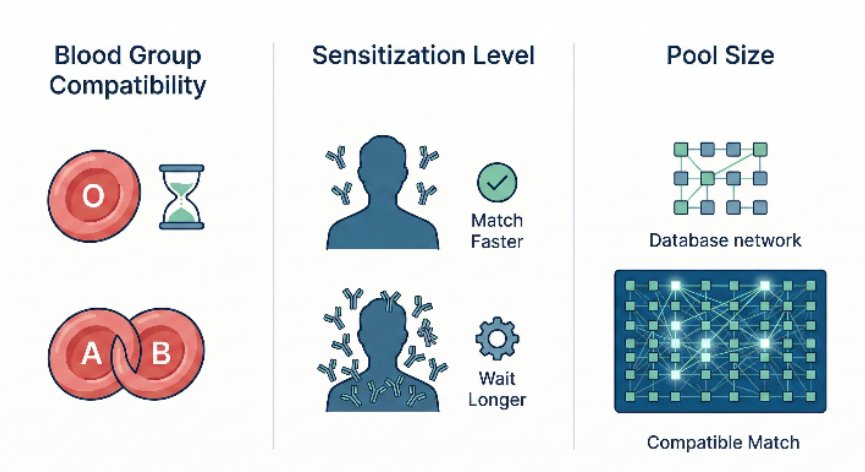
What Are the Factors That Affect How Long It Takes to Find a Match?
Finding a match in a kidney paired donation program can take from a few weeks to several years. Three main factors determine how quickly a recipient can be matched.
Blood Group Compatibility
People with common blood types usually find matches faster. Some groups face more difficulty:
- Blood group O recipients wait longer because they can only receive from O donors.
- AB donors are harder to place because fewer recipients can accept their kidneys.
- Sensitization Level (Antibody Load)
A recipient’s level of sensitization—how many HLA antibodies they have—strongly affects matching speed.
- People with few antibodies are matched more easily.
- Highly sensitized patients, often due to past transplants, pregnancies, or blood transfusions, have fewer compatible donors and therefore wait longer.
- Size of the Donor–Recipient Pool
The number of participants in the registry directly affects how quickly a match can be found. A larger pool increases the chances of finding a compatible donor.
Because our program collaborates with multiple centers and shares data with large registries, we can offer a higher likelihood of finding a suitable match as soon as possible.
Why a Larger Pool Improves Matching
A bigger registry provides several advantages:
- Proportional Success — As more pairs join, the number of successful transplants increases, especially when the pool includes more than 100 recipients.
Better Options for Hard-to-Match Patients — Large registries are the best chance for highly sensitized patients who often cannot find matches in smaller programs.