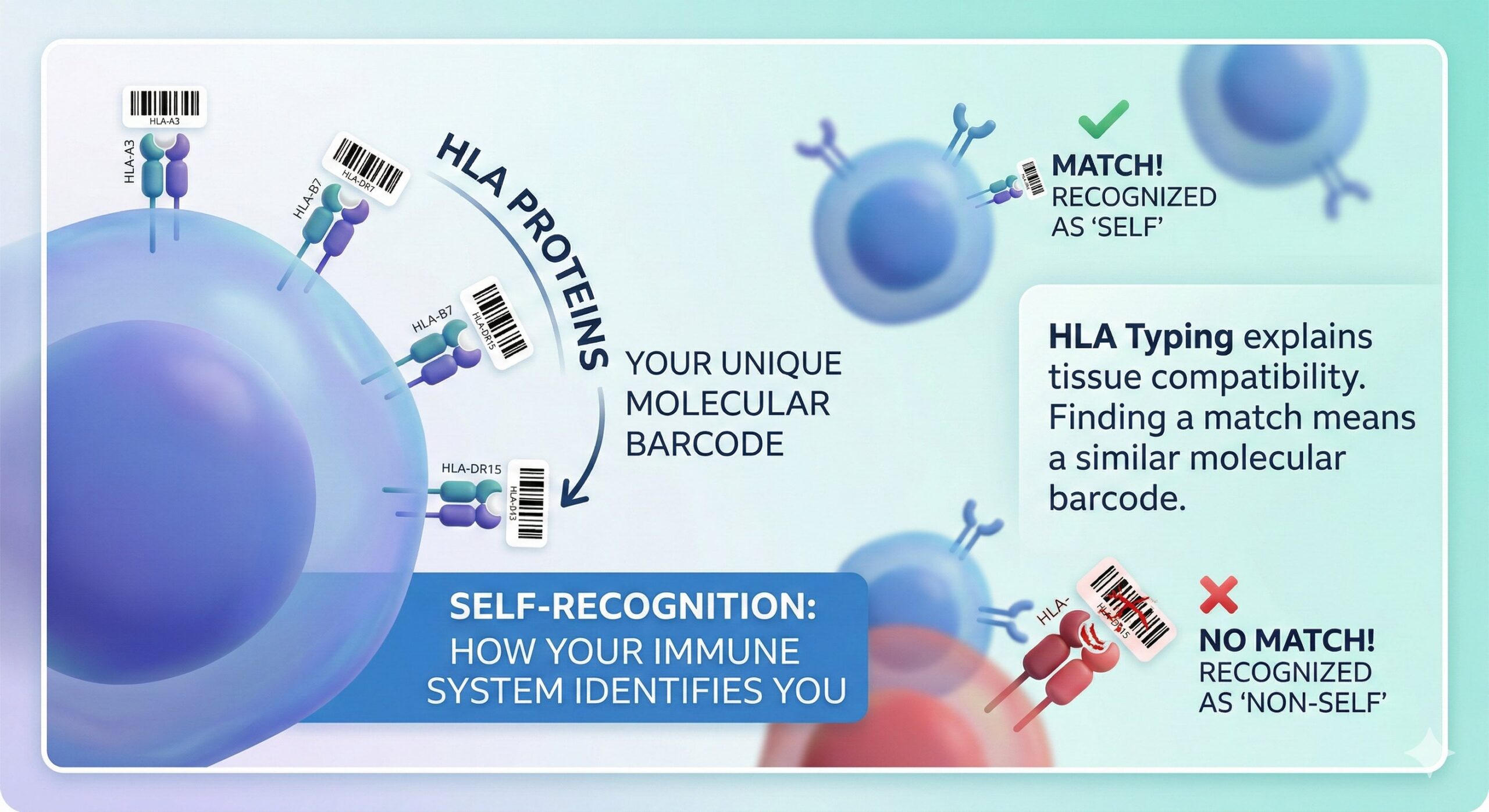
HLA typing is the laboratory process used to identify your specific “barcode.” In the context of a transplant, both the donor and the recipient must be typed to see how closely they match. We generally focus on two “Classes” of HLA:
Class
Major Types
Location
Class I
HLA-A, HLA-B, HLA-C
Found on all nucleated cells.
Class II
HLA-DR, HLA-DQ, HLA-DP
Found primarily on immune cells.
Both ELISA and Luminex Single Antigen Bead (SAB) are methods used to calculate a patient’s Panel Reactive Antibody (PRA) score.
1. PRA by ELISA (The Older Standard)
In an ELISA (Enzyme-Linked Immunosorbent Assay) test, purified HLA antigens from multiple donors are coated onto the bottom of a plastic well.
How it works: The patient’s serum is added to the well. If antibodies are present, they stick to the antigens. A chemical reaction then causes a color change, which is measured by a machine.
The Limitation: ELISA usually uses a “pool” of antigens. It can tell you that a patient has antibodies, but it struggles to identify exactly which specific HLA molecules are the problem.
Sensitivity: Moderate. It might miss very low levels of antibodies that could still cause a reaction during surgery.
2. Luminex Single Antigen Bead (The Modern Gold Standard)
Luminex technology is far more sophisticated. Instead of a flat plastic well, it uses microscopic plastic beads.
How it works: Each bead is color coded with a unique fluorescent “barcode.” Crucially, each bead is coated with only one specific type of HLA antigen (hence “Single Antigen Bead”).
The Analysis: A laser identifies the bead by its color (telling the computer which HLA antigen it is) and a second laser measures how many antibodies are stuck to it.
Sensitivity: Extremely high. It can detect tiny amounts of antibodies and provide a specific “strength” reading called MFI (Mean Fluorescence Intensity).
DNA Sequencing (Molecular Typing): This is the modern standard. Lab techs use PCR (Polymerase Chain Reaction) or NextGeneration Sequencing (NGS) to look directly at the patient’s DNA to identify which HLA alleles they inherited from their parents.
The Result: You get a report that looks like a string of letters and numbers, for example: HLAA02:01, B27:05, DRB1*15:01. The second digit defines the specific allele subtype, providing a more precise level of HLA matching between donor and recipient.