
What is the retroperitoneal approach for nephrectomy?
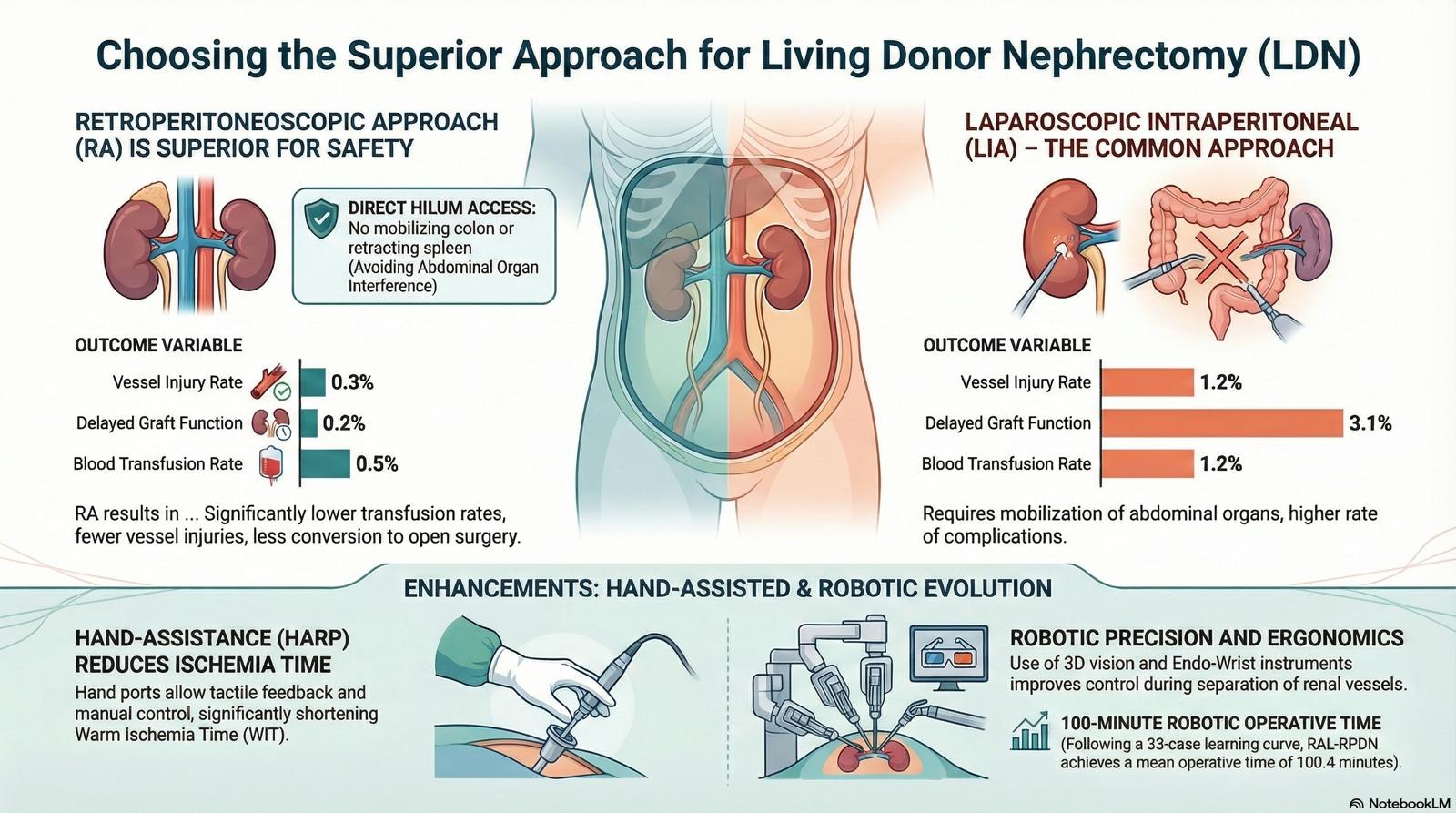
The retroperitoneal approach to nephrectomy is a surgical technique that accesses the kidney through the retroperitoneal space, where the kidney is located. Unlike other methods, it avoids the abdominal cavity. This approach is mainly chosen for living donor nephrectomies because it helps keep the abdominal organs untouched and safe.
Surgical Technique and Process
- Space Creation:
The procedure begins by creating a space between the abdominal wall and the peritoneum. Surgeons do this by gently separating the tissues by hand or by using an inflatable balloon to open the retroperitoneal area. - Direct Access:
After the space is created and filled with gas, the surgeon can directly reach the renal hilum, where the kidney’s artery and vein connect, as well as the ureter. - Organ Preservation:
Because the surgeon does not enter the intraperitoneal cavity, there is no need to mobilize the colon or retract the spleen (on the left side) or the liver (on the right side) to reach the kidney.
Common Variants
This approach has developed into several specific types, each offering different levels of help and accuracy:
- Retroperitoneoscopic (Pure):
This is a standard minimally invasive laparoscopic method performed entirely within the retroperitoneal space. As the scope is not in the abdomen (Lapar) but in the retroperitoneal space, it is called “retroperitoneoscopy”. - Hand-Assisted Retroperitoneoscopic (HARP/HARDN):
This version uses a special airtight hand port, usually placed through a lower abdominal incision. It allows the surgeon to use their hand for tactile feedback, manual dissection, and rapid kidney removal, combining the safety of laparoscopy with the control of hand assistance. - Robot-Assisted (RAL-RPDN):
This newer method uses robotic systems to provide 3D visualization and highly precise movements with special “Endo-Wrist” instruments, all while remaining in the retroperitoneal space.
Key Anatomical Advantages
- Virgin Abdomen:
This approach keeps the abdominal cavity untouched, avoiding areas where a patient may have scar tissue from previous surgeries. - Vascular Efficiency:
It offers a quicker and more direct route to the renal vessels, which can help reduce warm ischemia time during organ removal. - Intestinal Safety:
By staying outside the peritoneum, it significantly reduces the risks of postoperative ileus, internal herniation, and bowel obstruction.
Limitations and Risks
- Restricted Workspace:
The main challenge is the smaller working area compared to the traditional approach, which can make the surgery more demanding.
• Specific Complications:
Because the space is limited and close to the diaphragm, there is a risk of accidentally tearing the peritoneum or causing air to enter the chest cavity if the surgeon is not careful. However, our experience over the years has enabled limited dissection at the diaphragm and helped avoid such complications.
Kidney Paired Donation Program in Istanbul
If a donor is incompatible with the intended recipient, our Kidney Paired Donation Program in Istanbul may help identify a suitable alternative match.