
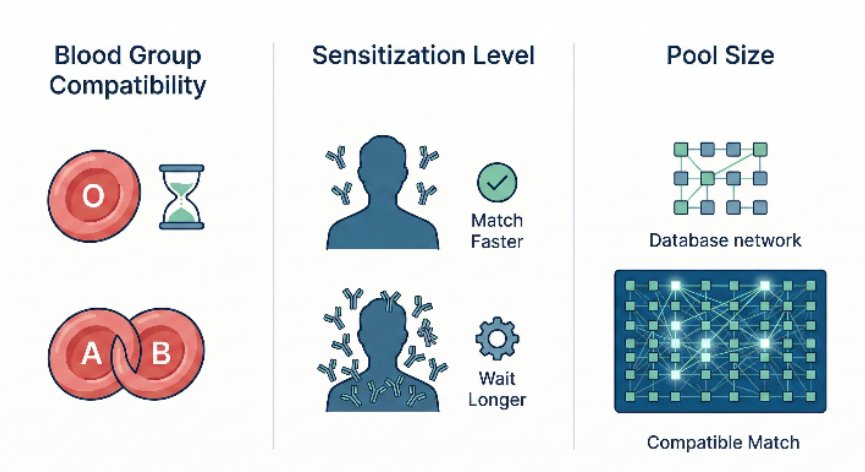
Which Patient Groups Are Typically Disadvantaged on KPD Waitlists?
According to the sources, some patient groups are often at a disadvantage in Kidney Paired Donation (KPD) registries because of biological and immunological differences. The primary disadvantaged groups include:
- Blood Group O Recipients: These patients are at a disadvantage because they can usually only receive kidneys from O-type donors. O-type donors are considered “universal” and are often matched with non-O recipients, making them rare. As a result, O-type recipients often wait longer, with a match chance as low as 15%.
- Highly Sensitized Patients: These patients have high levels of antibodies, often from past transplants, pregnancy, or blood transfusions, which makes it very hard to find a donor they will not reject. “Highly sensitized” usually means a Calculated Panel Reactive Antibody (cPRA) of 95% or more. Those with a cPRA of 97% or higher are the hardest to match and often stay on the registry the longest.
- Blood Group AB Donors: AB donors, and the pairs they are part of, are also disadvantaged and often wait longer. This is because AB kidneys can only go to AB recipients, who are rare.
- Blood Group B Recipients: In some cases, especially in non-directed anonymous donor (NDAD) chains, blood group B recipients may have fewer opportunities than other groups.
To address these disadvantages, our program uses mathematical methods to prioritize highly sensitized and O-type recipients. We also encourage compatible pairs—especially those with O-type donors and non-O recipients—to join the registry. This increases the number of O kidneys available for those who need them most.